
HTML-to-PDF SDK for .NET: Convert web content to PDF
Transform HTML files, webpages, and email documents into PDF with full rendering of images, CSS, forms, hyperlinks, and JavaScript. Convert from strings, files, or URLs, with complete control over page size and formatting.
HTML viewing and conversion toolkit
View HTML content, convert to PDF, and capture HTML streams with full support for CSS, JavaScript, images, SVG, hyperlinks, and forms. Instance pooling enables faster batch processing.
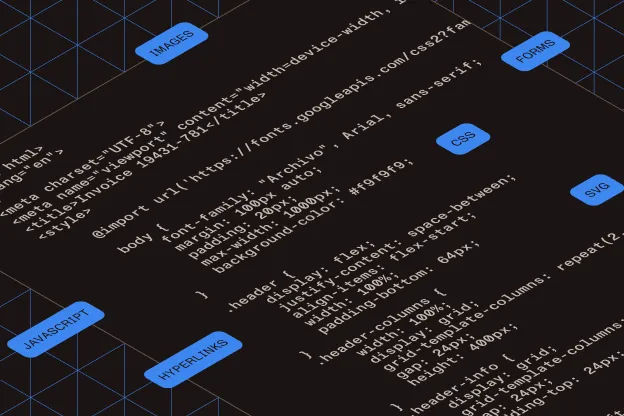
HTML viewing
Display HTML pages in WinForms and WPF viewers with complete rendering of modern web content.
PDF conversion
Convert HTML to PDF and capture HTML streams in DocuVieware for seamless web-to-document workflows.
Performance optimization
Manage a pool of browser instances for faster processing while maintaining full CSS, JavaScript, and form support.
Settings
Page width
Set the output page width in points. Default: 1920.
Page height
Set the output page height in points. Default: 1080.
CSS page size
Honor CSS-defined page sizes and adjust paper dimensions to fit content.
Browser path
Specify a custom browser path for HTML rendering.
Browser pool size
Configure the number of browser instances for parallel processing.
HTML-to-PDF use cases
Practical ways to use HTML support in your applications.
Webpage capture
Convert websites, blog articles, and online documentation to PDF for offline access, archiving, or editing in a viewer.
HTML viewing
Display and interact with HTML content directly inside your application’s viewer.
PDF integration
Insert HTML content into existing PDFs, convert standalone pages, or index HTML for search and retrieval.
Browser requirements
GdPicture.NET uses Chrome or Edge rendering engines for accurate HTML display. If either browser is already installed, no additional setup is needed.
If neither is installed:
- Download Google Chrome Portable and place it in the installation folder.
- Set the path to
chrome.exeusing theSetWebBrowserPath()method.

Demo
HTML-to-PDF viewer in action
Enter a URL to see how DocuVieware renders HTML content directly in the browser.
Loading HTML viewer...
GET STARTED
How to use
Download and install the GdPicture.NET package to access compiled demo applications and multi-language sample projects with full source code.
Explore demo apps
Find compiled demo applications in
\Samples\Bin\.Explore multi-language source code
Find C# and VB.NET demo apps and source code in
\Samples\WinForm\.Visit reference guide
Explore other code snippets within the online reference guide.
Example of usage
The example creates a PDF document from an HTML file.
using GdPictureDocumentConverter gdpictureDocumentConverter = new GdPictureDocumentConverter();// Load the source document.gdpictureDocumentConverter.LoadFromFile(@"C:\temp\source.html", GdPicture14.DocumentFormat.DocumentFormatHTML);// Save the output in a new PDF document.gdpictureDocumentConverter.SaveAsPDF(@"C:\temp\output.pdf");Using gdpictureDocumentConverter As GdPictureDocumentConverter = New GdPictureDocumentConverter() ' Load the source document. gdpictureDocumentConverter.LoadFromFile("C:\temp\source.html", GdPicture14.DocumentFormat.DocumentFormatHTML) ' Save the output in a new PDF document. gdpictureDocumentConverter.SaveAsPDF("C:\temp\output.pdf")End UsingTrusted by 3,000+ customers and Fortune 500 companies
15Y+
More than 15 years of experience developing our SDK
10K+
Trusted by more than 10,000 developers
Check out our other supported formats
Frequently asked questions
What functionalities does the GdPicture.NET HTML-to-PDF SDK offer?
The SDK provides comprehensive features, including:
- HTML viewing — Render HTML files, webpages, and email documents within applications.
- Conversion to PDF — Transform HTML content into PDF documents, preserving layouts and styles.
- Support for web technologies — Accurately process and render images, CSS, JavaScript, forms, and hyperlinks within HTML content.
- Flexible input sources — Convert HTML from strings, files, or URLs, offering versatility in handling various HTML content sources.
- Customization options — Control page size, margins, and formatting to tailor the output PDF to specific requirements.
These features enable the integration of dynamic HTML content into PDF workflows, enhancing document management and presentation.
Is a specific browser required for HTML rendering in the SDK?
Yes. The SDK utilizes Chrome’s rendering engine to ensure high-fidelity HTML processing. If Chrome or Edge is installed on the machine, the SDK will automatically utilize it. If not, developers can:
- Install Google Chrome Portable — Place it in the application’s installation directory.
- Specify the browser path — Use the
SetWebBrowserPath()method to define the path to the Chrome executable.
This setup ensures consistent and accurate rendering of HTML content.
Can the SDK handle dynamic web content, including JavaScript execution?
Absolutely. The GdPicture.NET HTML-to-PDF SDK fully supports the execution of JavaScript, enabling accurate rendering of dynamic and interactive web content within the converted PDF. This ensures elements such as client-side scripts and dynamic data are faithfully reproduced in the output document.
What customization options are available during the HTML-to-PDF conversion process?
The SDK offers extensive customization capabilities, enabling developers to:
- Set page dimensions — Define custom page widths and heights to match specific layout requirements.
- Adjust margins — Specify top, bottom, left, and right margins to control content positioning.
- Emulate media types — Choose between screen or print media types to influence CSS application and rendering styles.
- Control pagination — Opt to fit content into a single page, or distribute it across multiple pages as needed.
These options provide flexibility to tailor the PDF output to diverse application needs.
Is the GdPicture.NET HTML-to-PDF SDK suitable for high-performance applications?
Yes. The SDK is designed with performance in mind. It supports the management of a pool of browser instances, which can be configured to optimize processing speed and resource utilization. This feature is particularly beneficial for applications requiring the conversion of multiple HTML documents concurrently, ensuring efficient and rapid processing.
Is GdPicture’s HTML-to-PDF engine the same one used in Nutrient’s web and mobile SDKs?
Yes. GdPicture.NET belongs to the Nutrient product family, and the HTML rendering and conversion technology is consistent across Nutrient’s desktop, web, and mobile SDKs, delivering reliable web-to-PDF transformation across platforms.
60-day free trial