
AI-powered document data extraction
Automate data extraction from invoices, forms, and unstructured documents with ML-powered intelligent document processing. Add to your .NET applications: key-value pair extraction, table detection, smart redaction, and document classification. Built on 15+ years of OCR and AI refinement, with automatic template matching and confidence scoring.
Understanding unstructured documents
What are unstructured documents?
These are documents without predefined data models or standardized structure, representing 90 percent of all business documents.
- Not searchable without OCR processing
- Require manual data entry and review
- Cannot be processed by traditional automation
- Contain valuable data trapped in images and scanned text
What about PDF?
Most PDFs are unstructured. Even “digital” PDFs with selectable text lack the semantic structure needed for automation.
- Scanned PDFs are image-based and completely unstructured — text cannot be selected or searched
- PDFs contain text and images as individual graphic objects, but lack semantic structure for automated extraction
- Both types require IDP to transform visual content into structured, actionable data
How GdPicture intelligent document processing works
GdPicture’s intelligent document processing SDK combines multiple AI technologies — OCR with machine learning, natural language processing, computer vision, and pattern recognition — to extract structured data from unstructured documents.
Document layout analysis (DLA)
Document layout analysis identifies and categorizes regions within a document using geometric analysis. It detects tables, pictures, equations, and barcodes, and applies logical layout analysis to recognize paragraphs, lines, words, and individual characters — essential for understanding document structure before data extraction.
Optical character recognition (OCR)
Traditional OCR struggles with real-world documents — colored backgrounds, glare, skew, tables, varied font sizes, and underlined text require extensive verification. GdPicture.NET IDP uses an advanced OCR engine enhanced with AI technologies — including machine learning and deep learning — to handle challenging documents that would fail with standard OCR, extracting text accurately from complex layouts and poor-quality scans.
Textual content key-value association (KVP)
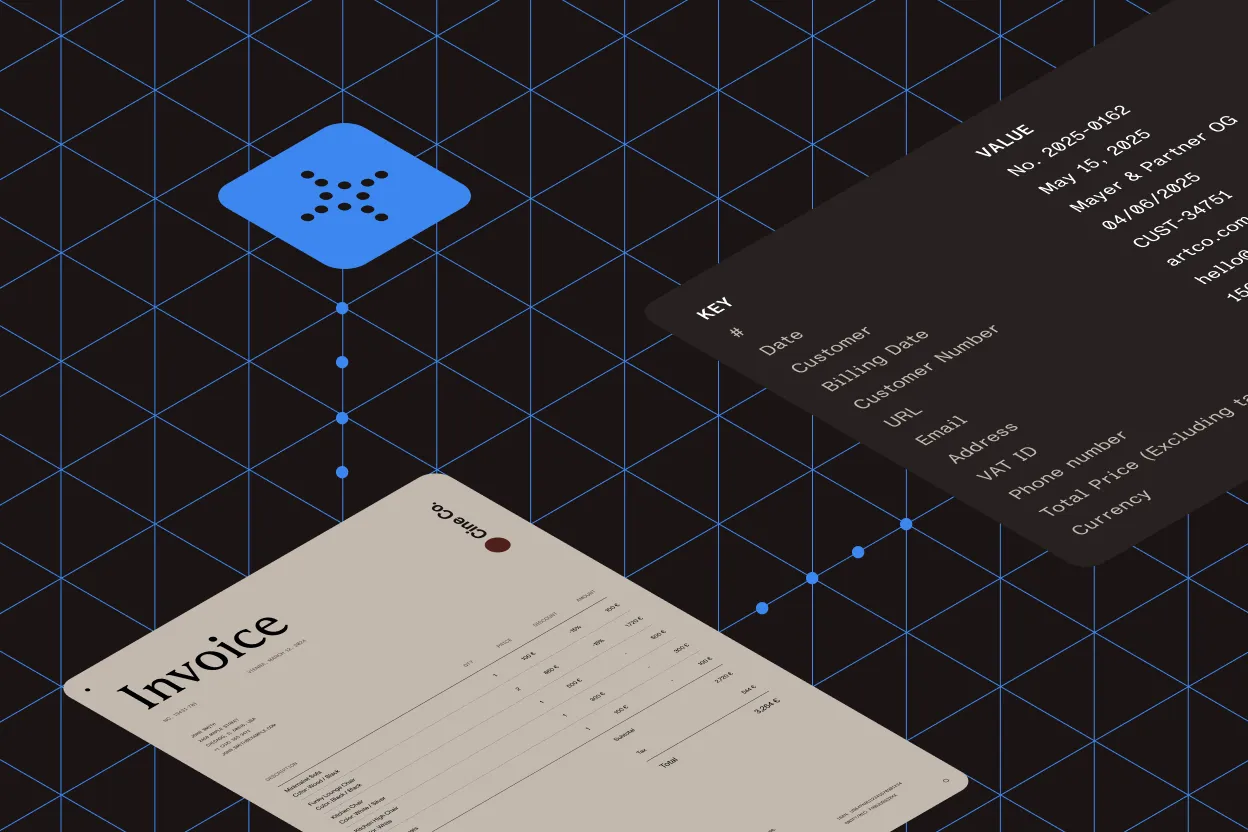
Key-value pairs are related data items where a key defines the data type and the value contains the actual information. IDP automatically identifies and extracts field relationships like “Invoice Number: 12345” or “Date: 01/15/2024” without manual templates, making it essential for extracting structured data from invoices, forms, and receipts where layout varies by vendor or document type.
Natural language processing (NLP)
AI technology that enables machines to understand human language in text and voice. NLP extracts meaning from unstructured documents by analyzing context, relationships, and semantics. Combined with deep learning, NLP makes sense of extracted information, identifying entities, understanding intent, and structuring data for automated workflows. It’s critical for processing documents with narrative content, like contracts and correspondence.
Named-entity recognition (NER)
NER is a specialized natural language processing technique that locates and classifies named entities in unstructured text into predefined categories — person names, ID numbers, addresses, organizations, dates, amounts, and account numbers. It powers key-value pair extraction and smart redaction by automatically identifying sensitive information, making it essential for automated data extraction and compliance workflows in invoices, forms, and identity documents.
Trusted by 3,000+ customers and Fortune 500 companies
15Y+
More than 15 years of experience developing our SDK
10K+
Trusted by more than 10,000 developers
Building IDP beyond .NET?
GdPicture is part of Nutrient, whose AI Document Processing extracts structured data from documents, scans, and images via Python, Java, and .NET — or a hosted Processor API.
Frequently asked questions
What is intelligent document processing (IDP) in GdPicture.NET?
IDP refers to a set of technologies that enable the extraction and processing of data from documents lacking a fixed structure, such as invoices, forms, and emails. GdPicture.NET’s IDP tools leverage optical character recognition (OCR) and artificial intelligence to interpret and manage unstructured data effectively.
What are the key components of GdPicture.NET’s IDP suite?
The suite is comprised of three main tools:
Table extraction — Recognizes and extracts tabular data, converting it into structured formats like Excel for easier analysis and processing.
Key-value pair (KVP) extraction — Identifies and extracts pairs like “Invoice Number: 12345” from documents, facilitating data structuring and indexing.
Smart redaction — Automatically detects and conceals sensitive information, such as personal identifiers, ensuring data privacy and compliance.
How does key-value pair extraction enhance document processing?
The KVP extraction engine utilizes a hybrid approach, combining heuristics, mathematics, and machine learning to accurately identify and extract data pairs. This technology addresses common OCR challenges, such as noisy backgrounds and skewed text, improving data accuracy and reducing manual entry efforts.
What is the benefit of smart redaction in document workflows?
Smart redaction employs natural language processing and computer vision to automatically locate and redact sensitive information within documents. This automation ensures compliance with data protection regulations and minimizes the risk of human error associated with manual redaction processes.
Can GdPicture.NET’s IDP tools handle various document formats?
Yes. The IDP tools are designed to process a wide array of document formats, including scanned PDFs, images, and more than 100 other file types. This versatility ensures organizations can apply intelligent processing across diverse document types without compatibility issues.
Is GdPicture.NET’s IDP technology related to what Nutrient offers in its web and mobile SDKs?
Yes. GdPicture.NET is part of the Nutrient product family, and the intelligent document processing technology is consistent across Nutrient’s desktop, web, and mobile SDKs, providing reliable document classification and data extraction across platforms.
60-day free trial